Digital marketing is one of the most widely used terms in today’s business world. Yet, for many founders, students, and even working professionals, it still feels abstract. What exactly does it include? Why has it become the backbone of modern growth? And how is it different from traditional marketing methods like billboards and newspapers?
This guide breaks down the concept in simple, human language without jargon, without complexity, so anyone can understand what digital marketing is and why it matters.
Digital Marketing: The Simple Definition
Digital marketing refers to any marketing effort that uses the internet or an electronic device to reach people.
Companies use digital channels such as:
- Search engines (Google, Bing)
- Websites & blogs
- Social media platforms (Instagram, LinkedIn, YouTube, TikTok)
- Online ads
- Mobile apps
…to connect with customers.
digital marketing is fundamentally about meeting people where they already spend their time - online.
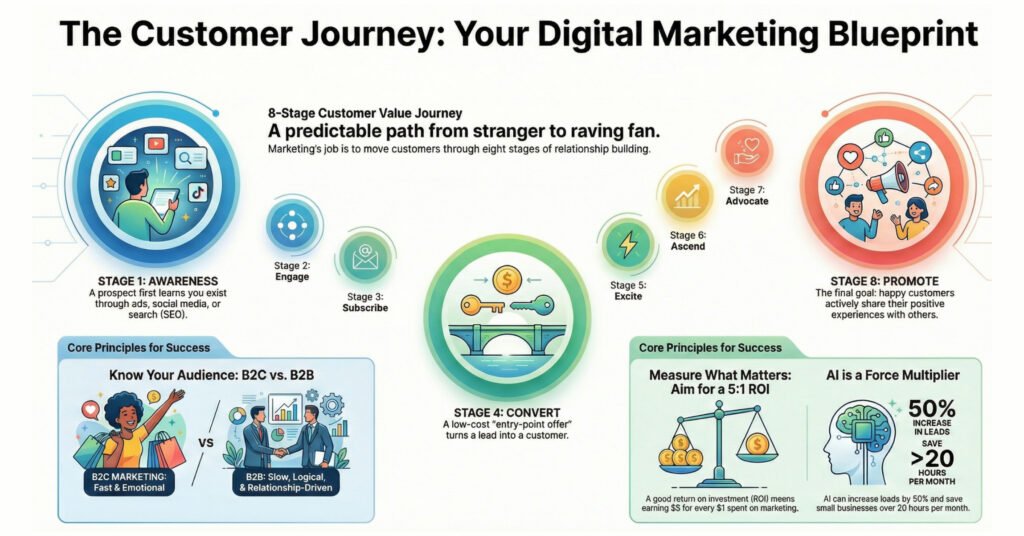
Traditional marketing interrupts people (TV ads, radio jingles).
Digital marketing starts conversations, builds relationships, and creates value.
Why Digital Marketing Matters More Than Ever
The modern consumer doesn’t wait for a salesperson, doesn’t rely on newspaper ads, and rarely watches TV commercials. They search online, compare options, read reviews, and engage with brands digitally.
Here’s why digital marketing has become essential:
✔ Global Reach (at local budgets)
Any business in Bengaluru can reach a customer in London or Singapore with the same campaign. This was impossible in the pure traditional era.
✔ More affordable than traditional channels
According to Vistaprint, digital marketing allows small businesses to start with modest budgets and scale as results improve. (“As per vistaprint.com, digital channels offer lower entry costs and better budget flexibility.”)
✔ Highly measurable
Digital marketing shows exactly:
- How many people saw your content
- How many clicked
- How many converted
This allows continuous optimisation - something offline marketing never offered.
✔ Personalisation
Modern tools allow you to send different messages to different audiences based on their behaviour, interest, demographics, or intent.
According to HubSpot, customers are more likely to buy when marketing is personalised because it feels more relevant and trustworthy.
How Digital Marketing Evolved (A Short History)
Digital marketing from the 1990s to the AI era. Here's a simplified version:
1990s - The First Websites
Basic, static pages. Companies only published information.
2000s - Social Media & Web 2.0
Platforms like Facebook, YouTube, LinkedIn changed marketing forever.
2010–2020 - Mobile-first revolution
The smartphone became the primary internet device.
2020–2025 - AI, Automation & Data
AI recommendations, chatbots, predictive analytics, GEO (Generative Engine Optimization), and personalisation at scale.
Digital marketing keeps evolving, and businesses must evolve with it to stay relevant.
What Digital Marketing Includes (The Full Ecosystem)
Digital marketing isn’t one thing. It’s a collection of powerful disciplines working together.
SEO (Search Engine Optimization)
The practice of improving your website so it ranks organically higher on Google.
Why it matters: Organic search brings highly qualified traffic(search Intent traffic) - people who are actively looking for what you offer.
Google uses hundreds of factors to rank content, including quality, relevance, backlinks, expertise (E-E-A-T) and user experience.
Example:
If your website appears on page 1 for “digital marketing strategy,” you earn free traffic every day without paying for ads.
SEM / PPC Advertising
SEM(Search Enginge Marketing or PPC (Pay per Click) is nothing but paid ads on Google, Bing, YouTube, partner networks and other.
Basically you bid on keywords -> Your ad shows instantly -> You only pay when someone clicks.
This is powerful for:
- Quick visibility
- High-intent customers
- Lead generation
Content Marketing
Creating valuable content in the form of blogs, videos, guides, infographics that educates rather than sells.
“Content builds authority and trust,” as noted in major industry sources like Content Marketing Institute and HubSpot.
Great content attracts, nurtures, and converts without aggressive selling.
Spotify Wrapped and Chipotle’s “The Scarecrow” campaign are excellent examples of content-led virality.
Social Media Marketing
Using platforms like Instagram, LinkedIn, and TikTok to build a community, engage followers, and promote your brand.
Case studies like Old Spice, Duolingo, and ALS Ice Bucket Challenge highlight the immense power of creativity + social engagement.
Email Marketing
Email marketing uses email to promote products, build loyalty, and connect with customers, acting as a direct, cost-effective digital marketing tool with high ROI, involving sending targeted messages (promotions, newsletters, updates) to specific customer segments, automating campaigns, and tracking performance via metrics like open/click rates to drive sales and engagement
Email works because:
- It’s permission-based
- Highly personal
- Ideal for nurturing leads
- Automated sequences scale effortlessly
Affiliate Marketing
You pay partners or influencers a commission for bringing sales or leads. This is a performance-based model, you only pay when you get results.
Example: You promoted X company’s product and someone bought it - The company will pay you a small amount/part of sales that is nothing but Affiliate marketing
Mobile Marketing
Optimisation for smartphones, including:
- Mobile ads
- Mobile apps
- SMS campaigns
- QR-based engagement
- Location-based targeting
The famous Tesco Homeplus virtual store in South Korea is one of the strongest examples of mobile innovation.
Marketing Analytics
The backbone of digital marketing - measuring everything through:
- Google Analytics
- Heatmaps
- Attribution models
- Dashboarding
This helps teams understand:
- What works
- What doesn’t
- Which channel drives the most ROI
Companies like Amazon and Starbucks rely heavily on analytics to personalise experiences and drive consistent revenue.
5. Digital Marketing vs Traditional Marketing (Quick Comparison)
| Category | Digital | Traditional |
| Cost | Lower | Higher |
| Reach | Global | Mostly local |
| Personalisation | High | Very limited |
| Measurement | Real-time | Approximate |
| Engagement | Two-way | One-way |
| Flexibility | Instant changes | Hard to modify |
Traditional marketing still works but digital offers speed, efficiency, and precision.
Who Needs Digital Marketing?
The short answer: Everyone.
But here are the top beneficiaries:
- Startups
- Small & medium businesses
- E-commerce stores
- Consultants & freelancers
- Educational institutions
- Healthcare providers
- SaaS companies
- B2B enterprises
Digital marketing = discoverability. If people can’t find you online, they will find your competitor.
Digital Marketing Is No Longer Optional
Digital marketing is not a trend. It is a transformation in how businesses communicate, sell, and grow.
Digital marketing today is:
✔ Data-driven
✔ Customer-centric
✔ AI-supported
✔ Always evolving
✔ More efficient than traditional marketing
Any business that ignores digital strategy risks being invisible in a world that lives online.