Digital marketing is not a single tactic. It’s an ecosystem, a set of channels working together to attract, engage, convert, and retain customers. Understanding these channels is essential for any marketer, business owner, or student looking to master online growth.
Why digital marketing channels matter now
According to Statista data, marketers worldwide spent close to 1.1 trillion US dollars on advertising in 2024, with global spend up about 7.3% year on year. The same analysis shows that digital channels now account for roughly 72–73% of that ad investment, or more than 790 billion US dollars, and that digital ad spend has more than doubled since 2019.
According to Oberlo, global digital ad spend alone is projected to reach around 740 - 800 billion US dollars between 2024 and 2025, with search advertising expected to capture about 306 - 307 billion US dollars and roughly 41% of online ad spend in 2024. In this landscape, simply “doing digital” is not enough - you need a deliberate mix of digital marketing channels aligned to your funnel, economics, and growth horizon.
This guide breaks down the core digital marketing channels - SEO, PPC, social media, email, and content marketing and shows how to turn them into a cohesive, data‑driven strategy.
What are digital marketing channels?
Digital marketing channels are the online paths through which your brand reaches, engages, and converts customers: search engines, social networks, email, websites, apps, and more. According to Adobe’s guide on essential marketing channels, the main types include search engine optimization (SEO), pay‑per‑click advertising (PPC), social media marketing, content marketing, email marketing, affiliate marketing, influencer marketing, and video marketing.
Strategically, you can group digital marketing channels into:
- Owned channels: website, blog, email list, mobile app
- Earned channels: organic search, social sharing, reviews, PR
- Paid channels: PPC, paid social, display, programmatic, sponsored content
Your job as a strategist is to design how these digital marketing channels work together to lower customer acquisition cost (CAC) while increasing lifetime value (LTV).
The core digital marketing channels
SEO: the compounding organic engine
SEO is the organic search marketing channel that improves your visibility in search engines like Google and Bing so that you earn traffic rather than buying it click by click. It turns high‑intent searches into a steady stream of visitors, leads, and revenue.
According to HubSpot’s marketing statistics and State of Marketing reports, SEO leads have an average close rate of around 14-15%, compared with roughly 1-2% for traditional outbound leads such as cold calls or direct mail, and about 16% of marketers say SEO delivers their highest ROI. HubSpot also notes that updating and reposting existing content can increase organic traffic by up to 106%, underlining how SEO and content are tightly linked.
Role of SEO in your channel mix
- Captures existing demand from users already searching for solutions
- Builds long‑term, compounding traffic and authority
- Reduces marginal acquisition cost over time compared with purely paid channels
Mini case example
According to internal case studies cited in HubSpot, one B2B SaaS company that systematically refreshed its top‑performing posts and built topic clusters saw organic become its largest non‑branded traffic source and SEO leads deliver the highest close rate in the CRM in line with industry benchmarks for organic search performance.
PPC advertising: precision and speed
PPC is the paid search and paid media marketing channel where you pay whenever a user clicks your ad on platforms like Google Ads, Microsoft Advertising, LinkedIn or Meta Ads. It is the fastest way to get in front of high‑intent audiences, especially for competitive queries or time‑sensitive offers.
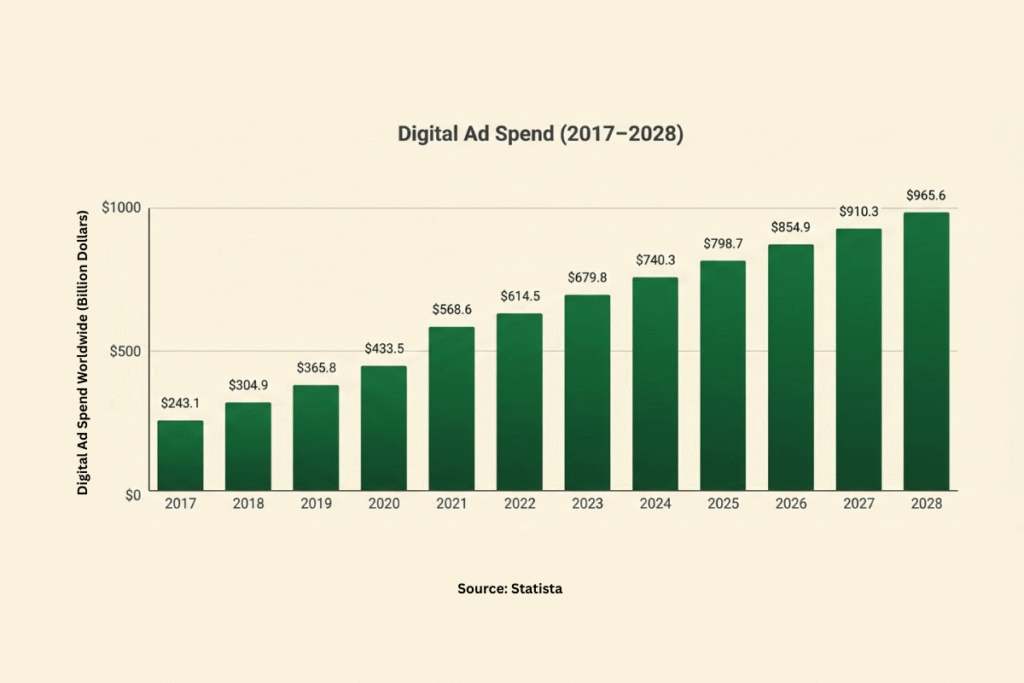
According to Oberlo’s digital ad spend analysis, global digital ad spend is set to reach around 740.3 billion US dollars in 2024 and about 798.7 billion in 2025, with search advertising projected at roughly 306.7 billion in 2024, accounting for about 41.4% of total online ad spend. Statista Market Insights similarly notes that marketers spent more than 3 in every 10 digital ad dollars on social media ads in 2024, with search remaining the single biggest format.
Role of PPC in your channel mix
- Generates instant traffic for new offers, product launches, and demand spikes
- Provides granular control over keywords, audiences, bids, and budgets
- Feeds keyword, creative, and audience insights back into SEO and content planning
Tactical PPC examples
Run rapid A/B tests on ad copy, value propositions, and landing page angles, then roll winning messages into your evergreen content marketing strategy.
Use PPC to dominate high‑value bottom‑funnel terms like “buy [product] online” or “[solution] pricing” while SEO works on broader informational queries.
Social media marketing: reach, community, and discovery
Social media marketing channels cover both organic and paid activities on platforms such as Facebook, Instagram, YouTube, TikTok, X.com, and LinkedIn. According to HubSpot’s 2025 social media and marketing statistics, social media is now ranked as the number one channel by reported ROI, and roughly 43% of marketers cite social as their primary marketing channel.
HubSpot’s 2025 social trends commentary also highlights that short‑form video, images, and live video are among the top formats for ROI, with short videos chosen as the single highest‑ROI format by about 21% of marketers. At the same time, social is evolving from pure awareness to full‑funnel: DataReportal’s synthesis of Statista data indicates that social media ad spend grew around 15% year on year in 2024, reaching close to a quarter of a trillion US dollars and accounting for more than 3 in every 10 digital ad dollars.
Role of social media channels
- Build top‑of‑funnel awareness and brand affinity
- Nurture community and advocacy through ongoing content and engagement
- Drive traffic to content assets, lead magnets, and product pages
- Provide a testing ground for hooks, formats, and narratives you can reuse in other channels
Mini case: HubSpot’s creator strategy
According to HubSpot’s own reported results from its creator collaborations, creator‑led content on Instagram increased reach and video views by up to 5x, engagement by 6x, and follower growth by about 82% compared with prior averages. HubSpot credits this to co‑creating content that feels native to each platform and using creators as an extension of their media strategy, not just as one‑off influencers.
Email marketing: the high ROI owned channel
Email remains one of the most cost‑effective owned digital marketing channels for nurturing and converting leads over time. According to HubSpot’s aggregated marketing benchmarks and email studies, average email click‑through rates often sit around 1.8 - 2%, and email is consistently ranked among the top channels for driving conversions and ROI, just behind or alongside social and SEO depending on the survey.
Mailchimp benchmarks quoted in HubSpot’s content show that segmented email campaigns achieve about 14% higher open rates and roughly 101% higher click‑through rates than non‑segmented campaigns. In other words, when you treat your email marketing channel as a personalized, data‑driven system instead of a broadcast tool, performance can double.
Role of email in your channel mix
- Nurtures leads captured from SEO, PPC, and social into sales‑ready opportunities
- Drives repeat purchases, cross‑sell, and up‑sell, increasing LTV and margin
- Provides a first‑party data asset that is resilient to third‑party cookie loss and tracking changes
Tactical email examples
- For ecommerce, implement browse‑abandon, cart‑abandon, and post‑purchase education flows that lift conversion rates and repeat orders.
- For B2B, design a 6 - 8 email sequence anchored on a core problem, mixing educational content, case studies, and soft CTAs toward a demo, trial, or consultation.
Content marketing: the glue across channels
Content marketing is the strategic creation and distribution of articles, videos, reports, tools, and other assets to attract, educate, and convert your audience. According to HubSpot’s marketing statistics, optimizing on‑page content based on keyword research is the top SEO tactic for nearly 40% of marketers, and blog posts remain among the top five highest‑ROI content formats, with around 22% of marketers citing them as a top performer.
HubSpot’s data also shows that refreshing and republishing content can more than double organic traffic (up to 106% gains), which underlines how content strategy and SEO are intertwined. Adobe and Coursera’s primers on digital marketing further emphasize that content is what powers almost every other channel: your search rankings, social engagement, email performance, and even sales enablement assets all depend on strong content marketing.
Core content formats linked to channels
- Search: long‑form guides, how‑tos, comparison pages, FAQs, and programmatic SEO content
- Social: short‑form videos, carousels, opinion posts, live streams, and UGC
- Email: newsletters, onboarding flows, product education, and offer campaigns
- Sales: case studies, ROI calculators, one‑pagers, demo videos, and battlecards
When you treat content as a product with a roadmap, QA, and iterations, every one of your digital marketing channels performs better.
Other important digital marketing channels
Beyond the core digital marketing channels above, several additional levers often play critical supporting roles:
- Affiliate marketing: According to Investopedia’s and Adobe’s overviews, affiliate marketing allows partners to promote your products in return for a commission, expanding reach with performance‑based economics.
- Influencer and creator marketing: HubSpot and many social trend reports show that brands increasingly rely on creators and influencers to unlock reach and trust, especially on Instagram, TikTok, and YouTube.
- Video and CTV advertising: Statista and Oberlo data indicate that digital video and connected TV (CTV) are among the fastest‑growing ad formats, driven by shifts in media consumption and the strong ROI marketers report for video content.
- Conversion rate optimization (CRO): While not a channel itself, CRO improves performance of all traffic sources by testing landing pages, funnels, and offers.
According to Oberlo and MarketingReport.one, the global digital advertising market is projected to reach 667 - 740 billion US dollars in 2024 and around 870 - 910 billion by 2027, representing over 70% of all media ad spend. As digital grows, these supporting channels become powerful levers layered on top of your core mix.
How digital marketing channels work together
The highest‑performing strategies use integrated digital marketing channels instead of isolated tactics. According to HubSpot’s attribution guidance, teams that connect CRM, analytics, and channel data are significantly more likely to rate their marketing as effective over 100% more likely in some segments.
A simple funnel‑based view:
- Awareness: social media, top‑of‑funnel SEO content, video, influencers
- Consideration: mid‑funnel SEO (“best X”, “X vs Y”), retargeting, webinars, guides
- Conversion: PPC on high‑intent keywords, product pages, CRO‑optimized landing pages, triggered email flows
- Retention and advocacy: email and SMS, communities, product‑led content, referral or loyalty programs
Example: B2B SaaS
- SEO targets educational queries like “what is revenue operations?” while PPC covers bottom‑funnel terms like “RevOps software demo”.
- LinkedIn and YouTube distribute short thought‑leadership clips linking back to pillar content.
- Lead magnets (benchmarks, calculators) capture emails; segmented nurtures run via the email marketing channel.
- CRM‑based attribution ties opportunities and revenue back to digital marketing channels and campaigns.
Example: D2C ecommerce
- TikTok and Instagram Reels drive discovery with creator content and social proof.
- Google Shopping and branded search ads capture ready‑to‑buy intent.
- Retargeting ads plus email and SMS flows close the gap for cart‑abandoners and browsers.
- Post‑purchase content and loyalty emails increase repeat purchase rate and LTV, improving the economics of all acquisition channels.
In both cases, the value emerges from interactions between digital marketing channels, not from any one channel alone.
Data-driven channel selection and budgeting
According to multiple industry forecasts from Statista, Dentsu, and Oberlo, digital will account for around 60-70% of total ad spend globally between 2024 and 2027, and will keep growing faster than non‑digital media. That makes channel selection and budgeting a board‑level question, not just a tactical one.
A practical framework:
- Start from business goals, not channels
- Define revenue or pipeline targets.
- Clarify time horizon (e.g., 3 months vs 18 months).
- Set CAC, LTV, and payback constraints with finance.
- Map goals to channel characteristics
- SEO & content marketing channels: slower ramp, higher long‑term ROI, best for education and compounding demand.
- PPC advertising: immediate and controllable, ideal for validation and high‑intent capture.
- Social media marketing channels: volatile but powerful for creative testing, awareness, and community.
- Email marketing channel: depends on list size, but excellent for monetizing and nurturing existing demand.
- Allocate baseline budgets (illustrative for a mid‑stage B2B SaaS or ecommerce brand)
- 30-40%: SEO and content marketing (production, technical SEO, link building).
- 30-40%: PPC and paid social for acquisition and experimentation.
- 10-20%: lifecycle marketing (email/SMS, CRM, marketing automation).
- 10-20%: experiments (influencers, affiliates, webinars, CTV, new formats).
- Instrument your stack for attribution and feedback
- According to HubSpot’s attribution documentation, robust tracking of channel‑level CAC, LTV, and assisted conversions is essential to understand which digital marketing channels truly drive revenue.
- Combine quantitative attribution with qualitative insight (e.g., “How did you hear about us?” fields and customer interviews) to surface dark‑social and cross‑device influence that raw analytics may miss.
Mini case studies from the field
Case 1: SEO + refresh strategy doubles organic traffic
According to HubSpot’s content marketing analyses, companies that systematically refresh and republish their best‑performing blog posts can see organic traffic gains of up to 106%. A mid‑market B2B firm applied this by auditing its top 100 blog articles, updating data and examples, improving internal linking, and aligning pages with current search intent.
Within six months, organic sessions to those updated articles increased by more than 80%, and organic search became the largest source of marketing‑sourced pipeline, confirming SEO as one of their most valuable digital marketing channels.
Case 2: Social + creators as demand accelerators
According to HubSpot’s 2025 social trends commentary, creator collaborations on Instagram drove a 5x increase in reach and video views, 6× higher engagement, and around 82% follower growth compared with the brand’s previous averages. HubSpot’s marketing team used this creator content not only for awareness but also to drive traffic into newsletters, webinars, and product pages, effectively linking social media marketing channels with email and product‑led content.
The lesson: social channels are shifting from a one‑way broadcast to co‑created ecosystems where creators, employees, and customers share the stage and push demand into your owned properties.
Case 3: Email segmentation lifts engagement and revenue
According to Mailchimp benchmarks cited by HubSpot, segmented email lists see approximately 14% higher open rates and about 101% higher click‑through rates than non‑segmented campaigns. An ecommerce retailer that segmented its list by category interest and purchase behavior - creating flows for first‑time buyers, lapsed customers, and VIPs - saw email revenue per subscriber rise significantly quarter over quarter.
Email shifted from a “monthly newsletter” box‑ticking exercise to one of their highest‑ROI digital marketing channels, and it also improved performance of paid acquisition by increasing LTV and allowable CAC.
Common mistakes with digital marketing channels
Even mature teams fall into predictable traps when working with multiple digital marketing channels.
1. Channel‑first, audience‑second thinking
Brands chase trends (“We need TikTok”, “We should start a podcast”) without clarity on their ICP, jobs‑to‑be‑done, or buying committee. According to HubSpot’s social media reports, the top social goals are increasingly brand awareness, engagement, and customer service, not just leads or direct sales, which means random channel hopping rarely aligns with outcomes.
2. Over‑reliance on a single channel
As Statista and Oberlo show, digital ad spend keeps rising, and competition within major platforms is intense. Brands that rely solely on Facebook Ads or a single SEO tactic are exposed to algorithm changes, platform policy shifts, or cost inflation. A resilient strategy balances several digital marketing channels with different risk profiles.
3. Ignoring retention and LTV
Many teams over‑optimize for first‑touch CPA while under‑investing in email, onboarding, and customer marketing. As digital channels absorb more of total media spend and CPMs rise, ignoring LTV is a fast path to negative unit economics.
4. Treating measurement as purely last‑click
HubSpot’s attribution guides emphasize that last‑click models systematically under‑value social, brand, and content marketing channels that influence consideration earlier in the journey. Leaders increasingly pair multi‑touch attribution with qualitative self‑reported attribution to capture dark‑social and word‑of‑mouth effects.
5. Under‑investing in creative and content quality
According to HubSpot’s content and social reports, short‑form video, UGC, and visual content are among the highest‑ROI formats, yet many brands still push out generic text posts and thin blog content. In crowded feeds and SERPs, creative quality is a non‑negotiable performance lever.
90‑day action plan to optimize your digital marketing channels
Use this 90‑day roadmap as a practical way to tune your digital marketing channels.
Days 1-30: Audit and insight
- Channel and funnel audit: Map each digital marketing channel to your customer journey and current metrics (sessions, leads, CAC, LTV, payback).
- Content and SEO audit: Identify top‑traffic and top‑converting pages, as well as content decay; shortlist refresh opportunities based on HubSpot’s demonstrated gains from updates.
- Data and tracking check: According to HubSpot’s attribution documentation, consistent UTM conventions, event tracking, and CRM integration are essential for meaningful channel reporting. Make sure your setup passes that bar.
Days 31-60: Quick‑win optimization
- SEO quick wins: Refresh and internally link priority pages, fix critical technical issues (indexation, speed, core web vitals), and align content with updated search intent.
- PPC tuning: Pause under‑performing keywords and audiences, shift budget into proven segments, and test 3–5 new ad angles based on actual customer pains and language.
- Email segmentation: Based on Mailchimp and HubSpot benchmarks, create at least 3 - 4 core segments (new vs returning, high value vs low value, engaged vs inactive) and design targeted flows for each.
- Social content system: Build a simple weekly calendar mixing educational posts, proof (case studies, testimonials), and narrative content, with emphasis on high‑ROI formats like short‑form video and UGC.
Days 61-90: Strategic bets and scaling
- Double‑down on winning channels: Increase investment in the top 1 - 2 digital marketing channels based on CAC, LTV, and sales feedback, while maintaining a presence in others for diversification.
- Experiment portfolio: According to Dentsu and other forecast reports, algorithmically enabled and emerging formats (such as CTV and retail media) are growing fast, so reserve 10 - 20% of spend for structured experiments.
- Cross‑channel plays: Launch at least one integrated campaign in which SEO content, paid media, social, and email all support the same narrative and offer, with unified tracking and post‑mortem analysis.
By day 90, you should have a clearer performance picture across your digital marketing channels and a repeatable process for reallocating budget toward the highest‑leverage opportunities.
Conclusion: making digital marketing channels work for you
According to Statista, digital marketing channels now capture well over 70% of global ad budgets, and their share is still rising year over year. According to HubSpot and similar sources, SEO, social media, email, and content marketing consistently emerge as the highest‑ROI channels, while PPC and other paid formats provide the speed and scale needed to hit short‑term targets.
The brands that win are not those chasing every new platform, they are the ones that design an intentional mix of digital marketing channels, invest in differentiated content and creative, measure what matters, and continuously reallocate budget based on data and insight. Anchor your strategy in your customer, choose the channels that best match their journey, and let your digital marketing channels compound in value over time.
FAQs about digital marketing channels
1. What are the main types of digital marketing channels?
According to Adobe’s digital marketing guides, Coursera’s digital marketing overview, and Investopedia, the main types of digital marketing channels are SEO, PPC advertising, social media marketing, content marketing, email marketing, affiliate marketing, influencer marketing, and video marketing. These can be grouped into owned, earned, and paid channels depending on who controls the asset and how reach is generated.
2. Which digital marketing channel has the best ROI?
According to HubSpot’s recent State of Marketing and social media reports, many marketers rank social media and SEO among their highest‑ROI channels, with around 16% naming SEO as their top ROI channel and social media collectively scoring as the number one channel overall. Email marketing also shows strong ROI, especially when lists are segmented and campaigns are automated, thanks to its low marginal cost and direct reach.
3. How should startups choose their digital marketing channels?
According to Coursera’s and HubSpot’s guidance for early‑stage companies, startups should choose digital marketing channels based on where their ideal customers already spend time and how quickly they need results. SEO and content marketing are powerful long‑term bets, while PPC and paid social give faster validation and acquisition; email should be layered in as soon as you can capture leads to increase LTV and resilience.
4. How do SEO and PPC work together as channels?
According to Google Ads documentation and industry best practices summarized by Adobe and HubSpot, SEO focuses on earning organic rankings while PPC buys ad placements for specific keywords and audiences. PPC is ideal for rapid testing and high‑intent terms, while SEO compounds over time; running them together lets you dominate key SERPs, share keyword and creative insights, and smooth out performance volatility.
5. Is email marketing still effective compared with social media?
According to HubSpot’s marketing statistics, email marketing remains one of the most effective channels for conversions and retention, with strong open and click metrics and significantly better engagement when lists are segmented. Social media, by contrast, excels at reach and discovery; the most resilient strategies therefore use both channels—social to acquire and warm audiences, and email to deepen relationships and drive revenue